JUly 2026
Briefed In
Legal insights from Baker McKenzie to power your business globally
In this issue, we explore how antitrust enforcement is evolving across the globe, how Pillar Two is reshaping deal strategies, how organizations can strengthen their cyber readiness and how AI is changing the mechanics of M&A.

Past is Prelude:
What’s ahead for global antitrust
Merger control remains at the heart of antitrust enforcement. Regulators in more than 40 countries can now review transactions that fall below notification thresholds, including smaller or incremental deals. Procedural compliance enforcement is on the rise, including fines for premature completion, breaches of clearance conditions and the provision of inaccurate or misleading information. Regulatory processes, including timing, sequencing and information management, have become more complicated as a result.
With global economies challenged by sluggish growth and rising concerns about economic competitiveness, the effectiveness of merger control is increasingly being measured against wider economic and other policy objectives.
Politicians want assurance that enforcement against deals that change the market structure will not undermine investment, scale or competitiveness, particularly in sectors seen as critical to economic resilience. That pressure is sharply visible in Europe and provides important context for the European Commission’s ongoing review of its merger guidelines.
Merger control: Tough enforcement, evolving expectations
Remedies are becoming more prominent again after several years of doubts. Regulators in the EU, the UK and the federal agencies in the US are increasingly willing to engage with dealmakers to resolve competition concerns through negotiated outcomes rather than blocking deals outright.
In the UK, the Competition and Markets Authority (CMA) has shown openness to solutions that do not involve divestments, including changes to company behavior or investment commitments, particularly in regulated industries. This reflects an effort to enforce competition rules as usual while at the same time allowing flexibility in how concerns are addressed, particularly where forcing a sell-off may be perceived as too heavy-handed.
For dealmakers, this renewed engagement brings opportunity, but also heightened expectations. Authorities increasingly expect early, well‑developed remedy proposals supported by credible implementation plans, with discussions starting much earlier in the review process.
Remedies: Openness to dialogue
Antitrust enforcement is increasingly shaped by geopolitical fragmentation. There is a sharper focus on competitiveness and resilience, alongside renewed attention to how competition policy supports innovation, productivity and long‑term growth in an increasingly multipolar economy.
How authorities reconcile robust enforcement with these wider economic objectives is becoming a defining feature of the global antitrust landscape. Against this backdrop, regulators are expanding their powers, broadening jurisdictional reach and relying more heavily on technology to support their work.
Alongside merger control, foreign direct investment (FDI) screening has become a core part of the transactional regulatory landscape. This is particularly true in sensitive sectors such as technology, healthcare, defense and critical infrastructure. In many global transactions, the number of FDI filings now equals or exceeds the number of merger notifications, with authorities actively monitoring non‑notified investments and stepping in to review deals where concerns arise.
FDI and foreign subsidies: A permanent feature
The European Commission’s publication of draft revised EU merger guidelines on 30 April 2026 was the most significant update to the EU’s merger control framework in two decades. By consolidating the assessment of horizontal and non‑horizontal mergers into a single, modernized framework, the Commission is not signaling a break with past practice but more clearly articulating how merger control should operate in today’s economic and geopolitical context. The legal standard remains unchanged, yet the draft gives sharper expression to a more dynamic view of competition, that looks beyond price effects to account for innovation, resilience and investment incentives.
For dealmakers, the shift is nuanced but meaningful. Transactions that enable businesses to scale, invest or combine complementary capabilities can now be framed more directly within the Commission’s analytical narrative, particularly where competitive overlaps are limited. Competitiveness is not a free pass, but it is no longer peripheral to the assessment.
That openness comes with higher expectations. The draft guidelines place greater pressure on deal parties to articulate a clear, evidence‑based theory of benefit, demonstrating how efficiencies, innovation or resilience gains flow from the transaction and translate into tangible consumer benefits, and why those benefits are credible and deal‑specific. Early alignment between buy- and sell‑side on deal rationale, economic evidence and regulatory strategy will therefore be increasingly important.
At the same time, scrutiny is set to intensify around ecosystem effects, future competition and pipeline innovation, particularly in technology and other sectors driven by innovation. This reinforces that preparation, robust evidence and credibility will remain decisive in navigating EU merger review.
Further reading:
European Union: The Commission’s proposed merger guidelines
Updated draft EU merger guidelines point toward a more dynamic view of competition
SPOTLIGHT
On the conduct side, cartel enforcement has regained momentum. Leniency applications are increasing, dawn raids are more frequent and authorities are investing heavily in digital forensics, whistleblowing tools, the prospect of financial rewards and data‑driven screening. The US Department of Justice Antitrust Division is increasingly focused on individual accountability and jail time. Agencies are also paying closer attention to how companies share information publicly, particularly through earnings calls, investor presentations and other market communications.
Labor markets have emerged as a core antitrust priority. Wage‑fixing, no‑poach agreements and the exchange of sensitive HR information are now treated as serious infringements, pursued with the same intensity as traditional price‑fixing cartels and, in some jurisdictions, carrying criminal risk.
Regulators are also scrutinizing the use of AI where this influences competitive behavior. The focus is less on AI as a technology and more on how it’s used in pricing, coordination or decision‑making, particularly where third‑party tools can help competitors to align behavior, or where automation blurs responsibility.
Cartels, conduct and expanding areas of risk
These developments demand a higher premium on judgement and execution. Regulators are asking more searching questions about proportionality, remedies and longer‑term effects on markets.
For businesses, outcomes will increasingly depend on greater preparation, understanding which risks are intensifying, where flexibility exists and how to substantiate strategic investment narratives in a more demanding but still navigable regulatory environment.
Looking ahead: execution, evidence and credibility
Developments expected in the second half of 2026 could have meaningful impact on how antitrust rules are enforced in Europe.
Q3 2026 – The European Commission will publish new guidelines on exclusionary abuses of dominance under Article 102 TFEU.
Q3 2026 – The European Commission is expected to propose changes that would expand its investigative powers in antitrust cases, potentially allowing it to step in earlier and gather evidence more aggressively during investigations.
Q4 2026 – The Commission is considering a new enforcement tool to crack down on practices that limit sales across EU borders.
Antitrust developments to watch




How Pillar Two is reshaping deal strategies
We sat down with Scott Levine (Partner, Washington, DC) and Sam Trowbridge (Partner, London) to explore how the latest Pillar Two developments are reshaping deal strategies and considerations for multinationals.
Can you give a quick snapshot of
the latest Pillar Two landscape?

The most significant Pillar Two development so far in 2026 has been the release of the Pillar Two Side-by-Side Package, which outlines several safe harbors including the Side-by-Side Safe Harbour. This safe harbor is a pivotal step toward reconciling Pillar Two obligations with the US minimum tax system and alleviating potential double taxation and compliance issues for US-parented multinationals.
In terms of Pillar Two's impact, it currently is being felt in every jurisdiction, and even companies that are not in scope should be paying attention.
Pillar Two only applies to entities with at least EUR 750 million of revenue for two of the last four accounting periods. However, if you are a target company that falls under the Pillar Two threshold and the acquiring group is subject to Pillar Two, you will be subject to these rules. US-parented companies engaging with a non-US parented company in scope of Pillar Two will also have to account for Pillar Two requirements.
What deal structures are being
most impacted by Pillar Two?

Pillar Two's EUR 750 million threshold means it isn't the case that it will impact every deal.
However, one type of transaction that is being heavily impacted is carve-outs. Pillar Two and the subsequent allocation of risk have already become a focus of carve-out due diligence. The general view is that the standard tools used to cover transaction risks, such as tax warranties or covenants, are mostly sufficient, and specific lines can be added to a tax covenant in the same way as you would with any other due diligence issue.
Another type of transaction to look at is a joint venture (JV). Because Pillar Two considers the threshold on a consolidated accounting basis, a scenario might arise where an entity underneath the threshold enters a JV with a large multinational, thus polluting the JV with Pillar Two risk. The question then becomes how do you allocate the risk caused by one party? Should the counterparty be indemnified for that?
Market positions are still being established around this, but it is typically the case that if one party is causing tax risk, they would provide an indemnity to the other party.
Levine: Ultimately, if a Pillar Two in-scope company or group acquires a group that isn't in-scope, that group now becomes a Pillar Two group. If you don't know what's lurking in its financials, it can cause all sorts of problems.
Adding on to the topic of risk of tax risk allocation for JVs, there is also a historical issue where one JV partner has a subsidiary that isn't subject to a top-up tax because it's in a jurisdiction without a Qualified Domestic Minimum Top-Up Tax (QDMTT). Participating in the JV might cause it to indirectly become subject to a top-up tax. That is usually something that needs to be agreed on and addressed in the transactional agreements.
Thankfully, at least from a US perspective, the recent Side-by-Side Safe Harbour provides a favorable answer to this for US partners of a foreign JV—they are generally not subject to a top-up tax. However, further guidance is still needed around how JV taxes should be allocated when a Side-by-Side Safe Harbour-eligible partner is part of a JV.
How does the global minimum tax change how companies approach cross-border transactions?
Trowbridge: There was a time when certain due diligence reports did not cover Pillar Two risks, and it felt somewhat like a transactional "blind spot." However, where relevant, Pillar Two is now a considered in detail (and might often be first on an advisor's list of concerns, thanks to the novelty and complexity of the Pillar Two regime). Increasingly, projected Pillar Two tax exposure is factored into valuation modelling, albeit in 10 years' time I would expect there to be a more consistent approach as the response to Pillar Two risk matures.
Another area to pay attention to is how warranty and indemnity (W&I) insurance approaches Pillar Two risk, since a large number of transactions use W&I insurance to cover potential due diligence exposures (especially for PE-backed transactions).
In terms of tax risks, W&I policies have weaknesses from a buyer's perspective due to certain exclusions under those policies. At least in Europe, these exclusions can include Pillar Two risks due to a lack of comprehensive due diligence outside of the immediate deal perimeter. This is relevant because Pillar Two risk often needs to be assessed across the whole of the seller group, even though a buyer might only be buying part of it.
As a consequence, risk allocation for Pillar Two can move away from the W&I policy and settle on the more traditional battleground of the purchase agreement between buyer and seller, where risk exposure depends on the commercial negotiations of the parties.
What are the key considerations for
navigating this new tax environment?
Levine: Companies will undoubtedly run into instances of unexpected top-up taxes and, in some cases, double tax events because of the local QDMTT. Companies therefore need to be proactive in identifying potential tax liabilities and inefficiencies and understanding their current tax structures in the context of the Pillar Two regime, the recent Side-by-Side Package and potential transactions.
There has been some discussion regarding non-US-parented multinationals exploring re-domiciliation to the United States for non-tax reasons, such as greater access to its deep capital markets and potential inclusion in a US stock index (though most of these projects started prior to the release of the Side-by-Side Package). While certain tax-related advantages may exist on the US side, those advantages will depend on an MNE’s specific facts and circumstances and must be weighed against the risk of future changes to the US tax system and its existing anti-inversion regime.
Executive briefing on cyber readiness
Vinod Bange, EMEA Data & Cyber Practice Chair, London
Cyber risk is one of the few threats that can rapidly disrupt core business operations. According to Baker McKenzie’s 2026 Disputes Forecast report, 80% of respondents identified technology and data risk as a key concern. Cyber readiness is not confined to IT or compliance functions; it’s determined by how effectively leaders manage risk across people, systems and decision‑making structures, particularly under pressure.
The following five principles highlight how cyber risk is materializing inside organizations and where leadership attention is most critical.

1
Cyber risk is systemic, not technical
Cyber incidents rarely stem from a single control failure. Threat actors typically probe organizations across multiple, interconnected dimensions, including technology stacks, identity management, internal processes, access control, third-party/supply chain access and human behaviors, to identify weak points. Strength in one area is often bypassed through vulnerability elsewhere.
Cyber risk should be managed through the lens of cyber governance meaning that it's an operational challenge and not simply a technology problem.
Strategic implication: Cyber risk assessments should have a dynamically shaped focus on mapping threat impacts across people, processes and technology, not infrastructure maturity alone.
2
Identity and human behavior are the primary attack surface
Credential compromise remains the most common point of initial access, and this risk is growing and materializing at an alarming rate. Threat actors deliberately prioritize individuals with operational access who are under time pressure or juggling multiple roles and responsibilities. As technical controls improve, attackers increasingly bypass systems by exploiting predictable patterns in human behavior, particularly situations where individuals act against policy despite knowing they shouldn’t.
Incident investigations consistently show that early stages of intrusion trace back to identity misuse and behavior, rather than technical vulnerabilities.
Strategic implication: Identity and access management, reinforced by role‑specific and scenario‑based training, should be treated as a primary risk control rather than a supporting measure.
3
Social engineering has evolved into real‑time manipulation
Social engineering is no longer dominated by mass phishing campaigns. Attacks now focus on targeted, interactive engagement designed to create urgency, exploit authority and use psychological techniques to apply pressure that yields results. AI‑generated audio and video can increase credibility, enabling convincing impersonation and compressing decision time. Deepfakes can make interactions appear legitimate, leading individuals to believe they are dealing with their managers or senior leadership.
Traditional controls struggle to counter these scenarios without governance safeguards embedded into decision-making processes.
Strategic implication: Decisions involving access, financial movement or system change should require verification mechanisms and processes that are resilient to impersonation and coercion on one person alone. Reliance on human judgement alone is no longer sufficient.
4
Geopolitics is now a structural driver of cyber risk
Cyber activity increasingly reflects geopolitical conditions. Shifts in geopolitics are a highly influential factor shaping cyber risk, with disruption, influence and strategic signaling as the primary motivations. These risks frequently propagate through supply chains, shared technologies and jurisdictional exposure.
While geopolitical signals are often visible, organizations frequently fail to translate them into timely preparedness. Leadership should remain alert to changes in the global environment and assess what they mean for their business risks.
Strategic implication: Cyber strategy and readiness should be reviewed regularly against geopolitical developments affecting markets, suppliers and data locations.
5
Outcomes are determined by governance, authority and rehearsal
The effectiveness of a cyber response is often determined in the first hours of an incident. Delays caused by unclear authority, contested escalation paths or untested decision rights materially increase impact. Organizations respond most effectively when leadership teams have rehearsed decisions, not just technical response procedures.
Rehearsals expose outdated assumptions, unclear accountability and governance gaps before they matter in a real incident.
Strategic implication: Incident response should be exercised as a governance discipline, with explicit decision authority, senior‑level involvement and integration into business continuity processes.
What this means for leadership
Cyber readiness is not defined by tools or policies, but by leadership capability under pressure. Effective cyber governance drives stronger readiness that allows leaders to understand where real exposure sits, establish structures that enable rapid and accountable decision‑making, and continuously test whether assumptions, playbooks and authority frameworks remain fit for purpose. Treating cyber risk as a leadership responsibility is now essential to organizational resilience.
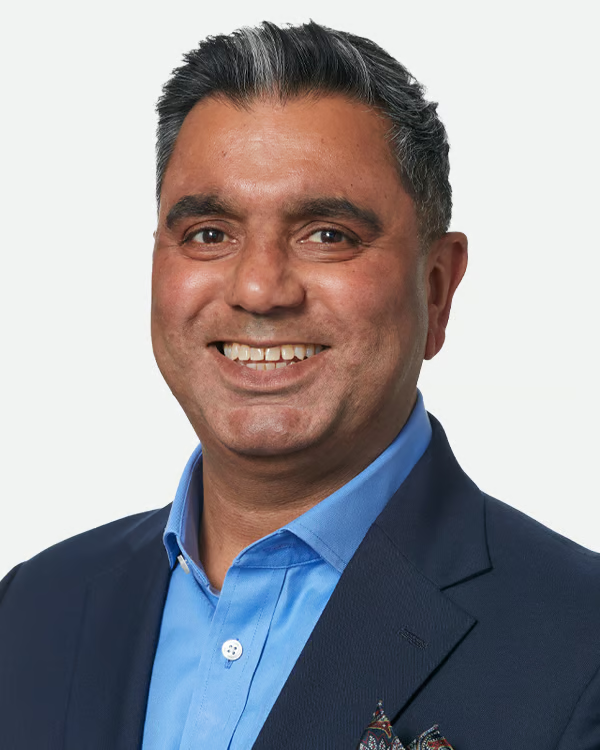
AI in M&A:
Faster analysis, sharper insight and new regulatory questions
As cross-border M&A grows more complex, AI is changing the mechanics of cross-border dealmaking—from diligence to risk management—amplifying the human judgment that ultimately defines success.
Cross-border M&A has always required careful coordination across jurisdictions. But today’s transactions involve overlapping regulatory regimes, digital assets and volumes of data that can overwhelm traditional diligence processes. Nancy Hamzo, an M&A partner at Baker McKenzie, and Ben Allgrove, the Firm’s Chief Innovation Officer (CINO), discuss why law firms are turning to AI to manage that scale, helping deal teams process information faster while keeping human judgment at the center of the work.
Cross-border transactions have always been complicated. What’s changed in the current deal environment?

What we’re seeing in transactions is illustrative of what’s happening across the legal market more broadly. You have geopolitical tensions, technological disruption to supply chains and shifting buyer dynamics all happening at once. The result is that deals are more complex than they used to be, and they’re often more urgent because companies are trying to get ahead of regulatory or political uncertainty.
At the same time, general counsel and CFOs are under pressure to deliver outcomes faster and at lower cost. This combination of complexity and urgency is what’s driving interest in technology and new delivery models across the deal process.

Much of our work focuses on large, multinational transactions—particularly carve-outs executed across dozens of jurisdictions. As deals grow in scale and become more multifaceted against a backdrop of rising geopolitical risk, the volume of regulatory, contractual and operational data increases exponentially. The real challenge today isn’t identifying an isolated legal risk; it’s understanding how regulatory exposure and diligence findings intersect across jurisdictions to influence enterprise value and overall closing risk.
Deals are more complex than they used to be… (and) at the same time, general counsel and CFOs are under pressure to deliver outcomes faster and at lower cost. This combination…is what’s driving interest in technology and new delivery models across the deal process.
Ben Allgrove, Chief Innovation Officer, London
Where in the deal process is AI currently adding the most value?
Allgrove: If you break down a transaction into parts, the obvious areas of immediate opportunity for AI are in diligence and deal structuring. But there isn’t yet an end-to-end technological solution that “does” deals. The AI silver bullet that people look for doesn’t yet exist. The reality is that AI can help with parts of the process, not the whole thing. And what we’re seeing is targeted use of technology in particular parts of the deal process where it can genuinely add value by enhancing the insight and diligence lawyers already apply to complex transactions.
Hamzo: As a junior associate, I spent countless hours creating comparison charts, extracting provisions from contracts and doing quick analyses across multiple jurisdictions. I remember thinking to myself: “There has to be a better way to do some of this work.” Clients don’t really want to pay for manual processing—they want to pay for our analytical skills—our ability to identify risk, solve problems and guide them to a conclusion that’s beneficial for the deal and for them.
Due diligence, as Ben mentioned, is often one of the largest cost drivers for clients in a transaction. AI helps us get past that initial layer of processing data to quickly analyze large numbers of contracts, flagging key issues like change-of-control restrictions or assignment clauses and synthesizing internal knowledge and information across jurisdictions. That allows us to reach the risk assessment much sooner and stay focused on the strategic insight and problem-solving clients actually rely on us for.
If AI can process so much information, why can’t transactions simply be standardized?
Allgrove: Every transaction has its own unique dynamics. Clients bring different risk tolerances, commercial priorities, different personalities and regulatory exposures, which means no two deals that come to us ever look the same. In carve-outs, for example, we used AI to take complicated tax slide decks and convert them into the beginnings of legal step plans: extracting the information needed to build out the documentation and actions required to implement the transaction, but it does not work out of the box for all deals. Our lawyers and computer scientists still need to close the last mile.
AI can also help with initial drafting of key transaction documents, benchmarking agreements against deal studies and identifying nuances a client has insisted on in previous transactions. But these tools don’t standardize and automate the transaction itself. It’s about giving deal teams the ability to see the full landscape sooner: to connect issues across jurisdictions, understand how risk accumulates and give clients sharper, faster guidance. AI accelerates the analysis; the architecture of the deal—the calibration of risk, the commercial judgment, the strategic trade-offs—remains fundamentally human.
Hamzo: What we’ve discovered through a lot of trial and error is that it’s actually quite hard to standardize transaction-related tasks, even with AI. You might get most of the way there, but you’ll always need specialists dealing with the peculiarities of that deal. That’s why we created our Applied AI team—a group of lawyers and technologists who work directly on client projects. Their role isn’t to build products. It’s to sit alongside our deal lawyers and design workflows for specific transactions. For example, on large deals where tax structures change constantly, we’ve built workflows that take updated structures and automatically cascade those changes through the transaction documents and work plans. But you can’t simply lift that workflow and drop it onto the next deal. You take the core building blocks and then apply a custom layer on top specific to the next deal, because every transaction has its own peculiarities.
Nancy Hamzo, M&A Partner, Toronto
The legal profession is about people, relationships and trust. AI is just one tool. It can accelerate the process, but responsibility for the outcome—and the judgment behind it—will always sit with the lawyers advising on the transaction.
As AI becomes embedded in diligence and risk analysis, what does good governance look like? How are regulators approaching its use in legal work?
Allgrove: We start from the proposition that we need to use this technology. Our professional responsibility as lawyers is to deliver the best possible legal service at the best possible price, which means using the technology responsibly rather than ignoring it. Issues like bias in models, data protection and client confidentiality are non-negotiable, and ultimately we remain responsible for the output that comes from using these tools. That means controls such as human-in-the-loop review and quality assurance are non-negotiable.
It’s also important not to frame this as a binary where people are perfect and technology is flawed. People make mistakes as well, but the difference is that law firms control how people are recruited, trained and supervised. With AI, we’re using models built by external technology companies who are not willing to warrant the outcomes of their tools to the same level that law firms do, so the question becomes how risk is managed across that supply chain.
We began thinking about these questions well before the current wave of generative AI. The Firm developed its first AI strategy in 2017, planning to ensure we had the skills to adopt and use new technologies as they became fit for our legal purposes.
Hamzo: We are still not at a point where there are uniform global rules, but the regulatory direction is unmistakable: greater scrutiny, clearer disclosure and a focus on integrity of AI-assisted analysis. What’s emerging is less about restricting AI and more about ensuring that its use supports fair competition, national security interests and market stability. Regulators are increasingly paying attention to transparency, explainability and accountability—how decisions are made, what inputs are used and who is responsible for the outcomes generated by AI.
Ultimately, this accountability remains with the dealmakers and advisors. Clients shift risk to us—that’s part of the model, so anything we do with AI has to be thoughtful and transparent. Technology helps us work smarter and process information faster. The essence of transactional practice remains the same: applying judgment, making trade-offs and guiding clients through complexity with clarity and confidence.
The legal profession is about people, relationships and trust. AI is just one tool. It can accelerate the process, but responsibility for the outcome—and the judgment behind it—will always sit with the lawyers advising on the transaction.
Originally published in collaboration with WSJ Custom Content as part of M&A Matters.





You have a significant focus on cross-border and multi-country transactions. What’s the most memorable roadblock you’ve had to overcome to get a deal done?
I’ve had so many memorable and funny moments doing these deals over the years. One is when we were acting for a family-owned Swiss logistics business and the CEO on our side travelled everywhere with his two large dogs. They were supremely well-behaved and sat very quietly and calmly in the corner but when the other side became a bit aggressive with their arguments, they would get up and bark at the investment bankers and lawyers—much more effective a job than we could ever have done! Another one was trying to run down a consent from a seller’s ex-spouse in the Czech Republic in the middle of the night as a completion deliverable. Needless to say, she wasn’t particularly incentivized to get it to us quickly. There had to be a separate negotiation to procure her signature, and the entire global completion was held up for this. Not the most effective forward planning by the seller!
What makes the Baker McKenzie network unique in supporting cross- border deals?
We were built for it. Our coverage geographically and from a specialist (both sector and practice) perspective is unmatched, as is our experience dealing with complex cross-border issues. Our people join us because they enjoy and want to do these deals, and it shows.
The business landscape only ever seems to become more complex. Between geopolitical turmoil, increased regulatory and antitrust scrutiny, the rise of AI—how do you steer clients through those challenges? How do you help clients to maximize opportunities in the face of what appears to be so much risk?
To be honest, the private equity funds I work with are all over all these issues and probably have a greater tolerance for risk than most others. It is very interesting helping them work through their options. I think the key is really having business discussions with them rather than just conversations focused on your area of expertise. Their needs are changing, so being alive to the help they need and thinking differently and creatively about these are important.
Which aspects of your role do you find most rewarding?
Right now, I think it is actually having the ability to effect change in the Firm. When the management team agrees on a course of action, we can implement fairly quickly and that is great. There's nothing more demotivating than having agreement on direction and action but not being able to make it happen.
You joined the Firm in 1998. How have you seen it change over the years?
Tremendously. I think as you get more senior in the Firm, you experience different aspects of it as well, but apart from that, I think we're much more ambitious, diverse and operating in a completely different space in the market now than we were then.
What advice would you give your younger self to help steer you through the world of work?
It sounds very basic, but I would tell her not to worry as much as I did about everything. And also to be braver than I was. A lot of people might seem very clever and intimidating from afar but when you finally get to interacting with them, they are really just like everyone else. And many are not as invincible as they might seem.
What does your role on the Global Management Committee (GMC) entail and can you talk about your ambition for the Firm in the coming years?
My role on the GMC mostly involves talking and listening to many people to hear varied points of view and making a lot of decisions, which try to balance the multiple competing, sometimes opposing, viewpoints to meet our goals and do what we think is right for the Firm as a whole. We all have the same end goal—every one of us has the same desire for success of the Firm—but there are multiple ways of getting us there, so on the GMC we are trying to find the best path.
I'd love to see us grow in confidence about who we are and the value we bring to the table for our clients; I'd love to see more successful women coming through into the partnership and leadership with ease; I'd love to see us get to where we belong: at the very top of the global elite firms, doing even more of the complex, headlining, cross-border mandates, we were built for—always being the first firm of choice for these mandates. We can achieve all these things with the right determination, persistence and hard work.

